
TICKETS
GET YOUR TICKET
23 October to 7 November 2026

KLANGLICHT 2026 explores the theme of time, drawing visitors into the unique world of Eggenberg Palace and fostering a dialogue between historic architecture and contemporary art. This unique venue becomes not merely a backdrop, but the very starting point for an artistic exploration of time, history, order and change. Light and sound reveal hidden connections, allowing the palace to be experienced in new dimensions.

Map
01

Spaces of Time

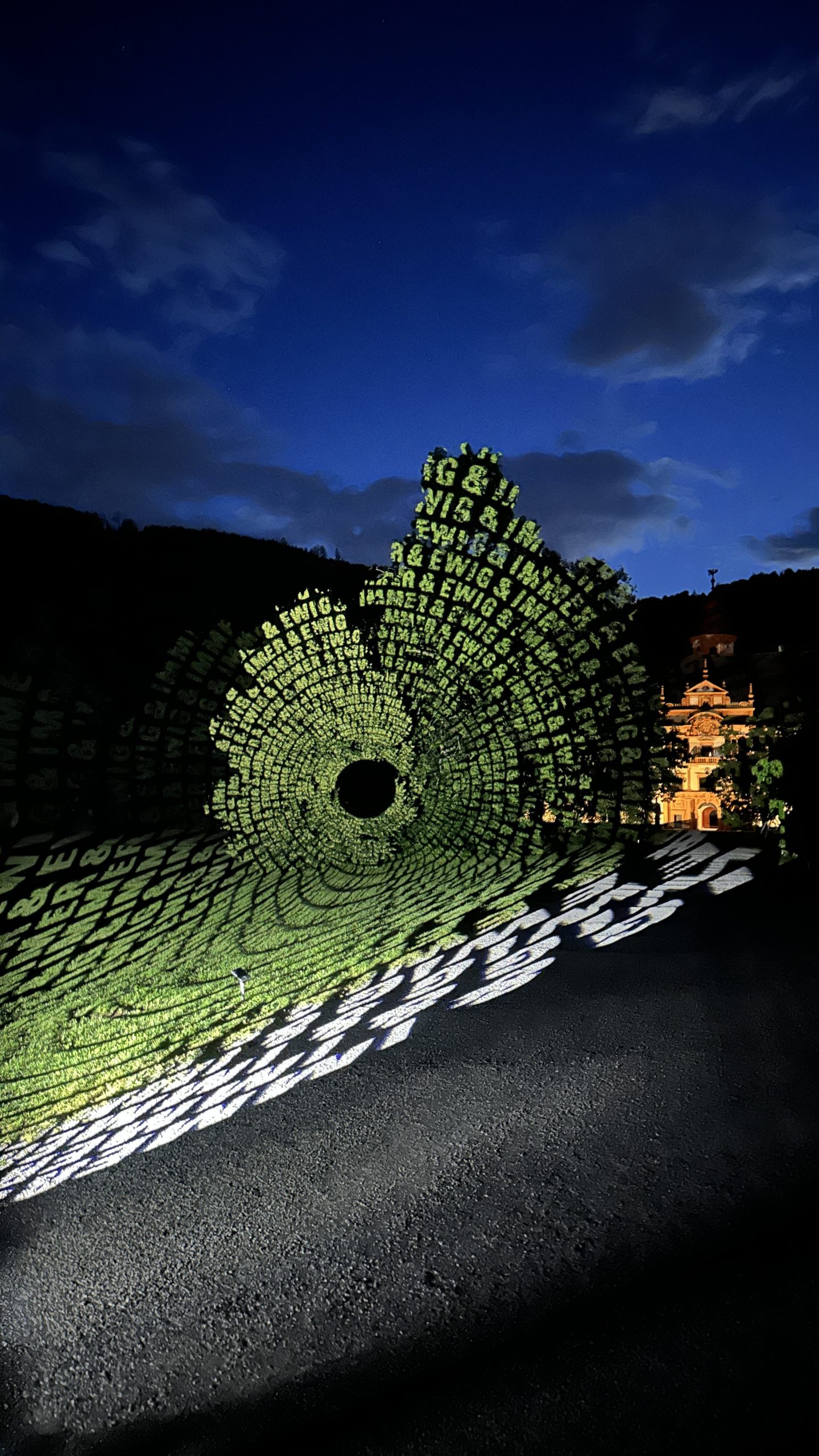
Hartung & Trenz
+

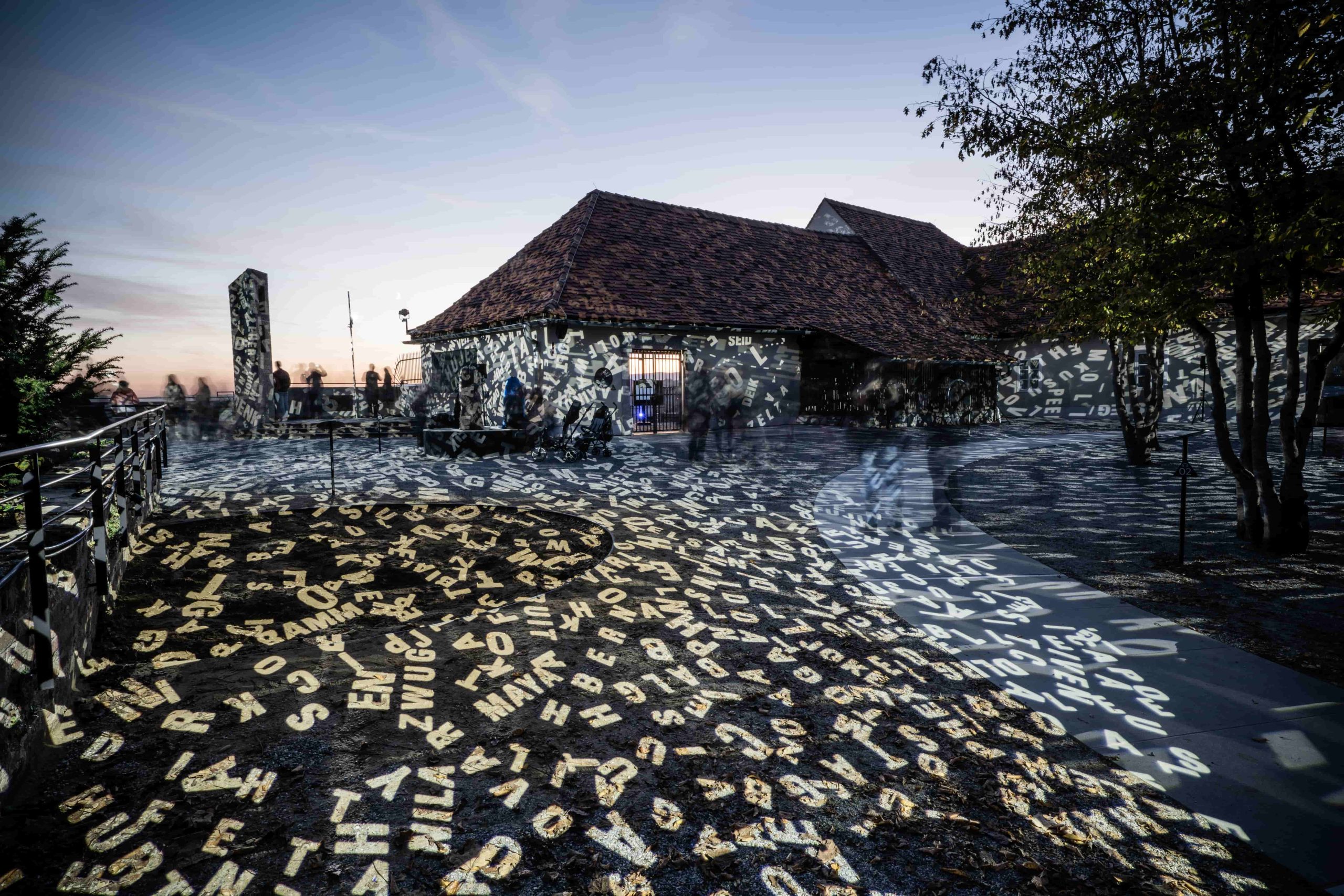
Remembering and forgetting, blossoming and withering, becoming and being – Hartung & Trenz explore the diversity of temporal experience through text, light and sound. Along the avenue of Eggenberg Palace Park, ‘Spaces of Time’ unfolds as a large-scale artwork that conceives of time not as a linear sequence, but as a personal experience of walking and seeing. The message emerges through movement, as the projected texts change with every step. Like blank lines, the spaces in between provide time and room to reflect on what has been seen. Parallel to these word-images, acoustic spaces emerge, the sound of which changes depending on one’s location. And last but not least, nature is also an essential component of the installation: the avenue, with its clusters of trees, and the surrounding flora and fauna enrich the artistic spaces with further movement and depth through their own vitality.

Biography
Over the course of their more than 20-year collaboration, Detlef Hartung and Georg Trenz have developed their own form of artistic expression, through which they transform texts into striking images. Concrete language becomes pictorial symbols, both in content and form. The resulting word-images create expansive image-text spaces that enter into a dialogue with the real, three-dimensional spaces onto which they are projected.

Credits
Concept & Artistic Work: Hartung & Trenz
Sound: Timber Hemprich

This installation was realized with the kind support of the Kronen Zeitung realized.
02

Cadences

Daniel Rossa
+

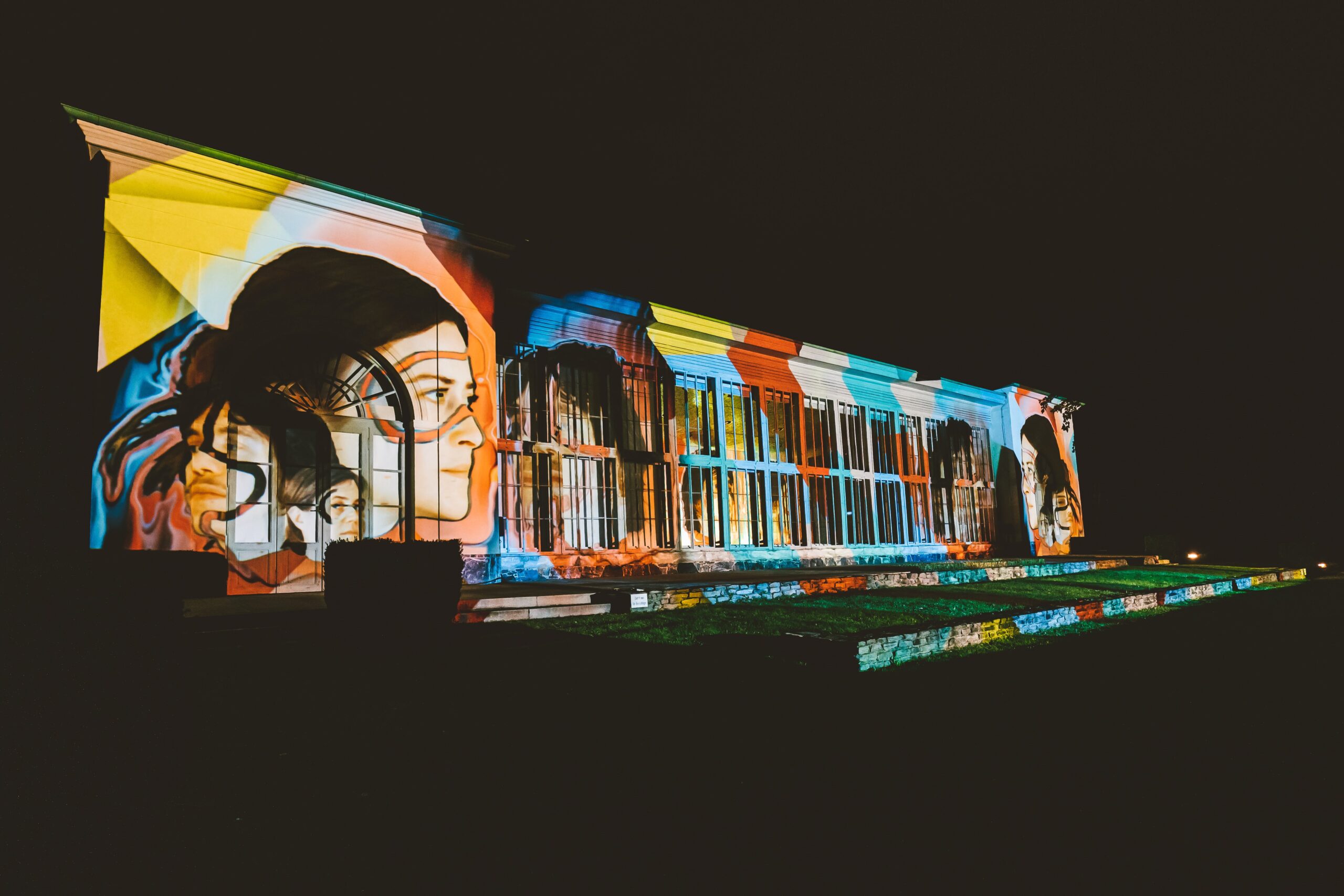
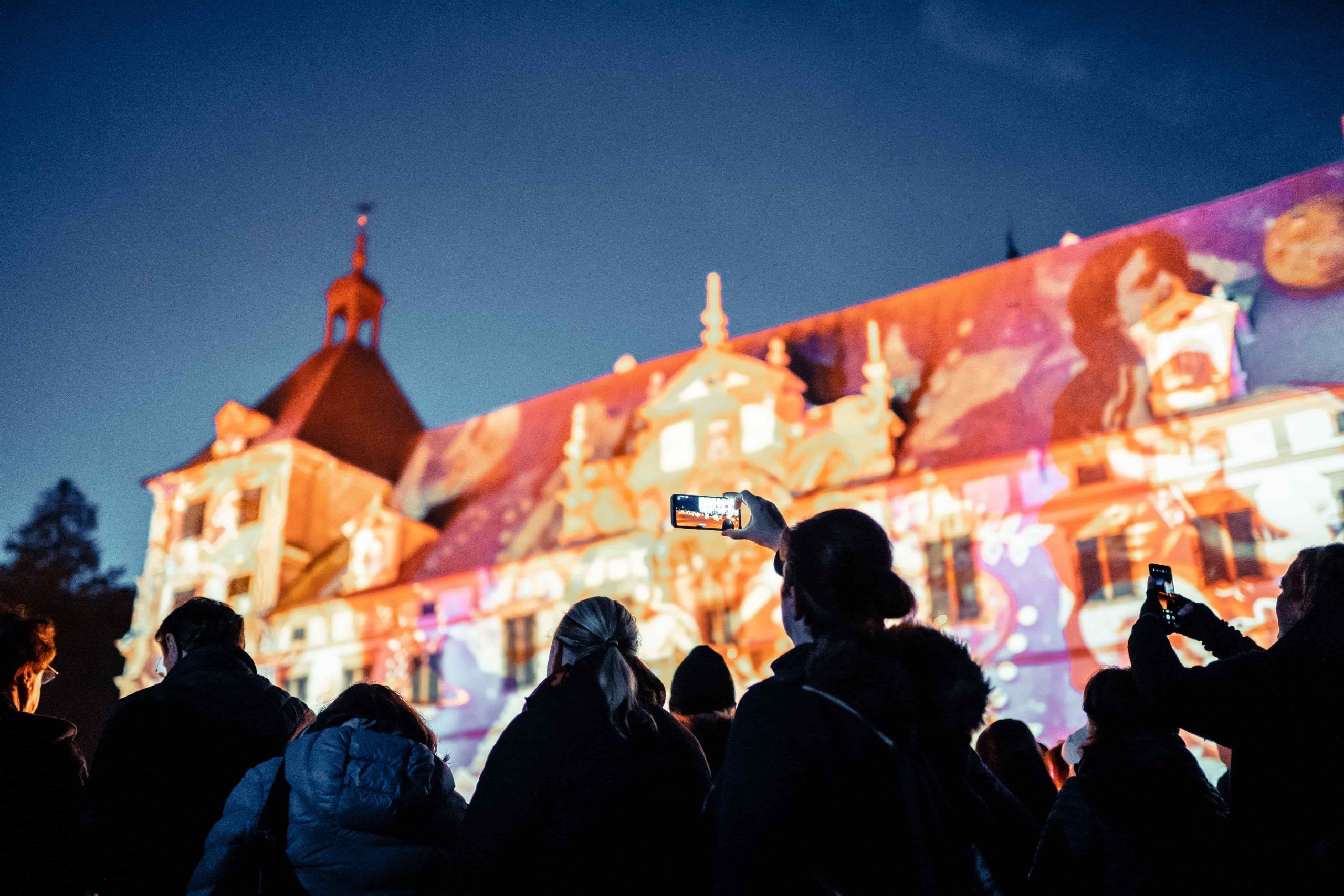
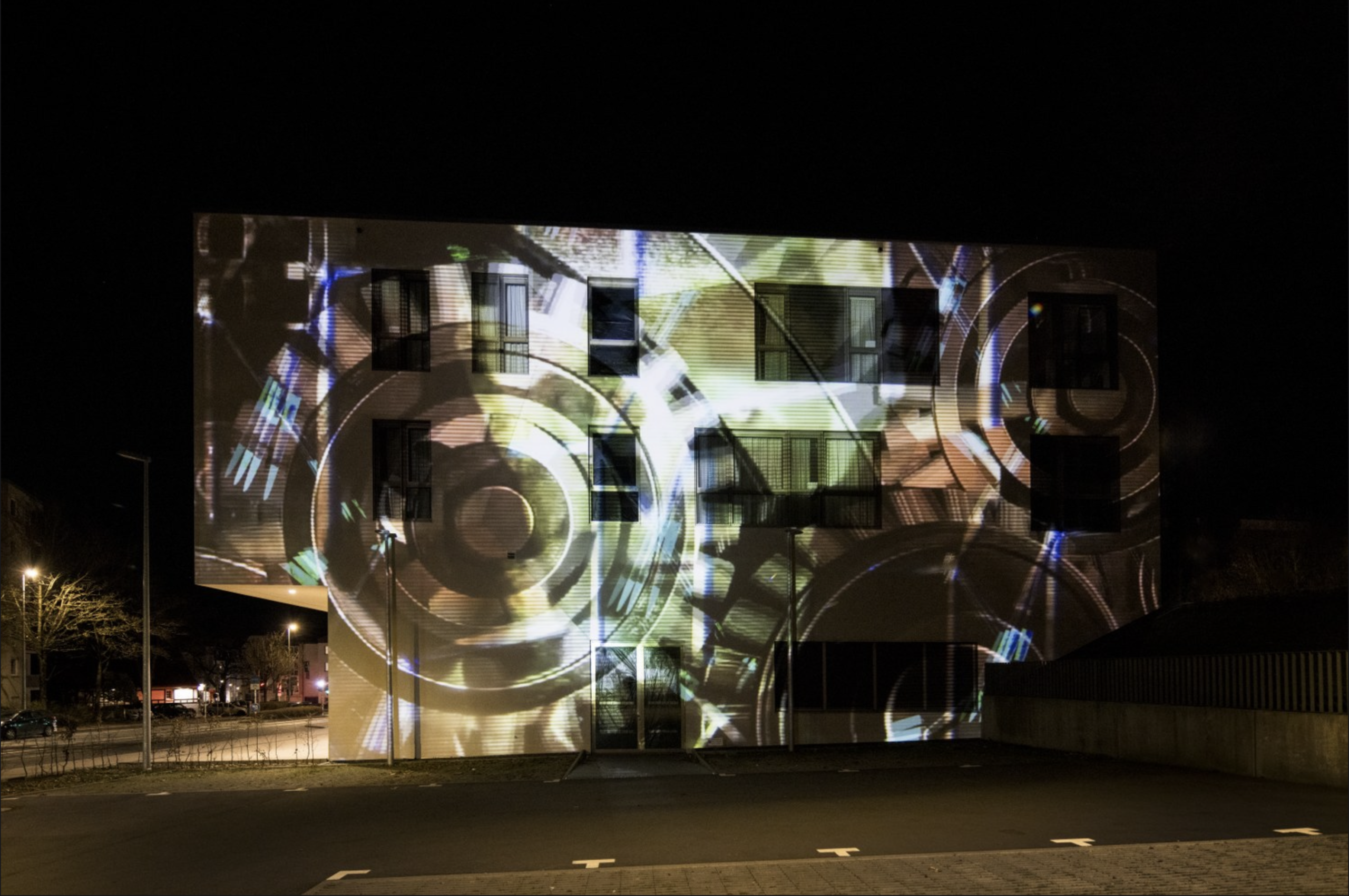
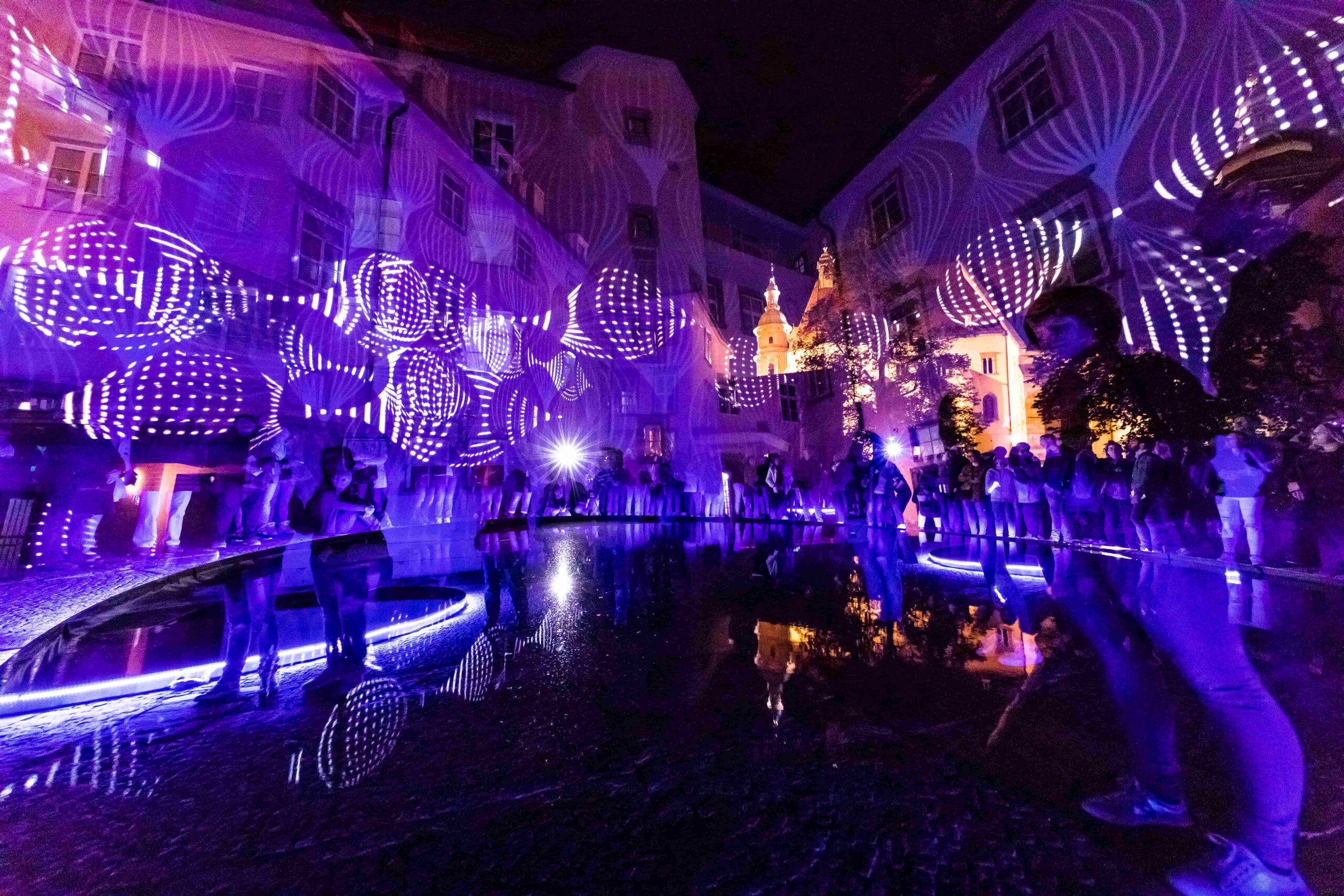
How do we view a historic building today that was created under entirely different social conditions? What significance does this encounter between different eras hold for us? Daniel Rossa’s art navigates the tension between preservation and transformation – as is the case with his façade projection at Eggenberg Palace. Through light, colour and movement, an image emerges that neither stages nor creates an illusion of the site, but rather renders it visible and interpretable in a new way.
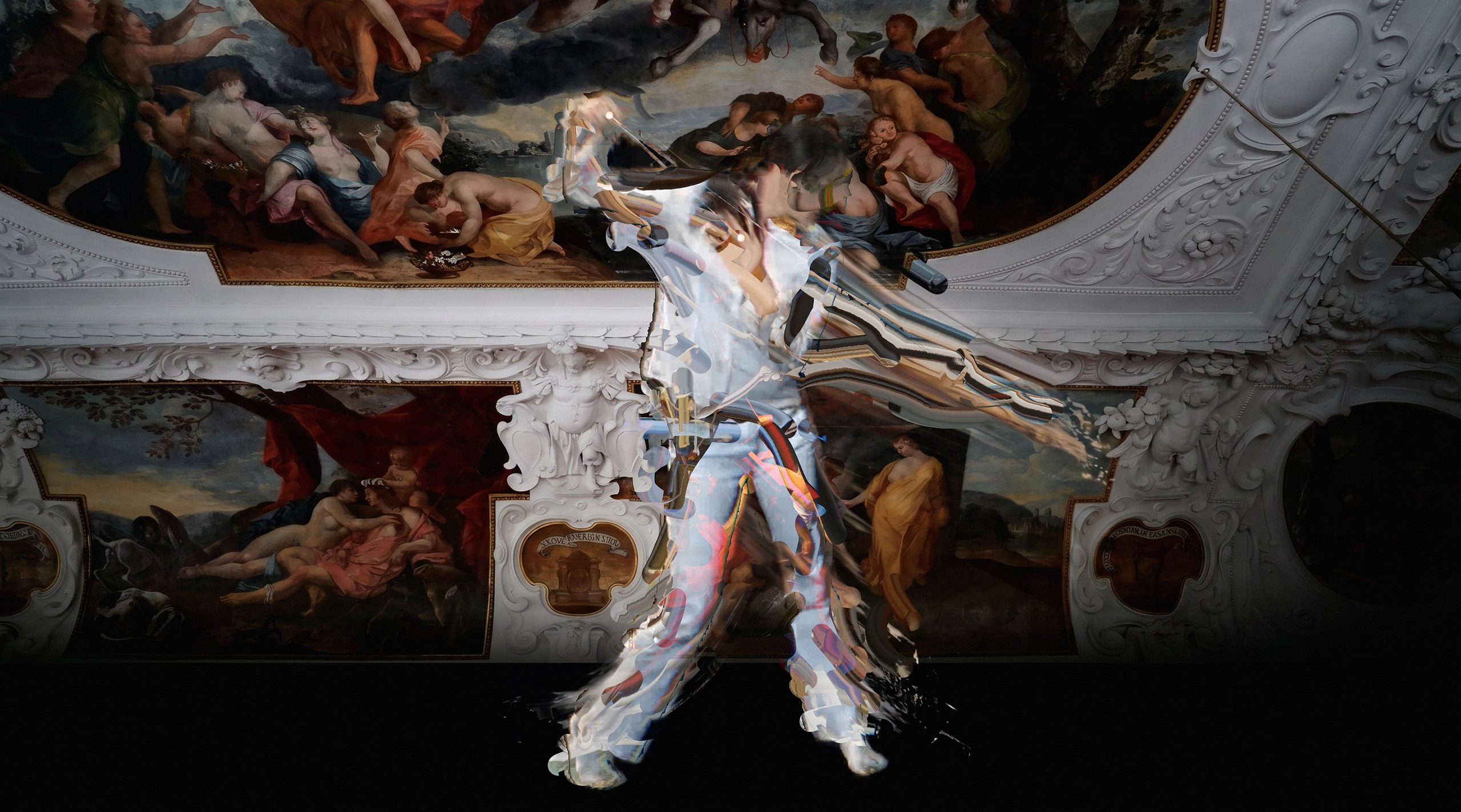
Starting from a precise digital reconstruction, the German media artist examines the palace in terms of its form, proportions and symbolism, and develops a contemporary language from this. In this language, the original order dissolves; images of the Baroque interior are turned inside out, only to be progressively abstracted further by the movements of a dancer. From the Baroque structures emerges a contemporary perspective on the building, one that seeks, above all, a dialogue between history and the present.

Biography
Daniel Rossa is a German media artist whose work emerges at the intersection of architecture, light, and digital media. He studied at the Bauhaus University in Weimar, whose interdisciplinary approach—combining art, design, and technology—continues to shape his artistic practice to this day.
At the heart of his work is an exploration of architecture as a living medium. For his site-specific projections, Rossa develops precise digital models of historical and contemporary buildings, which he transforms into new visual narratives through light, movement, and algorithmic processes. His works examine the relationship between physical space and digital perception, moving between documentary precision and abstract transformation.
Daniel Rossa’s works have been presented internationally, including at the Sydney Opera House, the Saatchi Gallery in London, and the Elbphilharmonie in Hamburg, as well as at numerous international light art and media art festivals. For his work, he has received awards such as a Cannes Design Lion and the German Lighting Design Award.
For KLANGLICHT 2026, Daniel Rossa is developing “Kadenzen,” a work conceived specifically for the façade of Eggenberg Palace, which places the historic building in a dialogue between Baroque order and contemporary visual language.

Credits:
Concept & Artistic Work: Daniel Rossa
Sound: Iona W

This installation was realized with the kind support of our festival sponsors E-Werk Franz and XAL realized.

03

Whispering Mountains

Eness
+

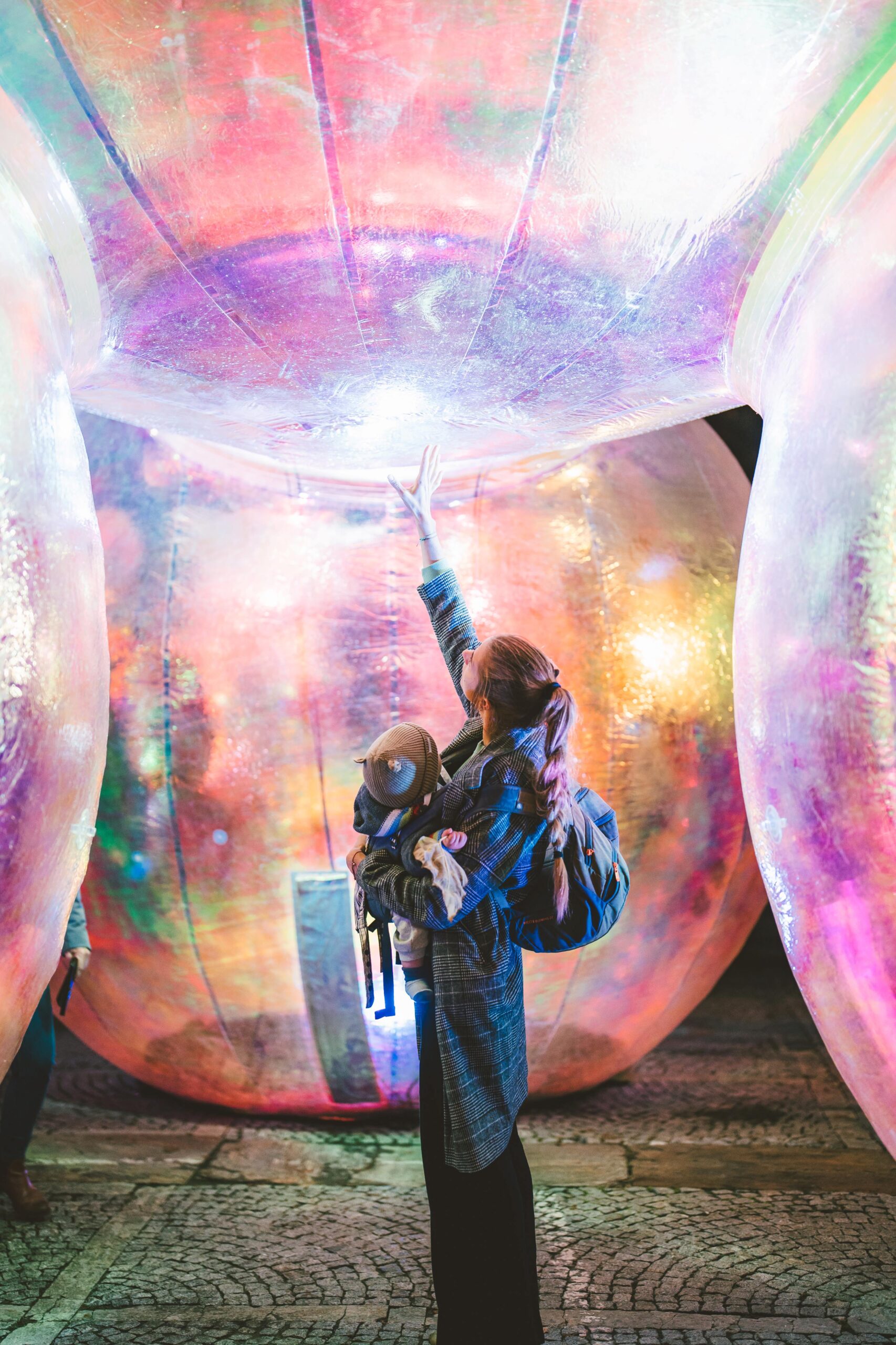
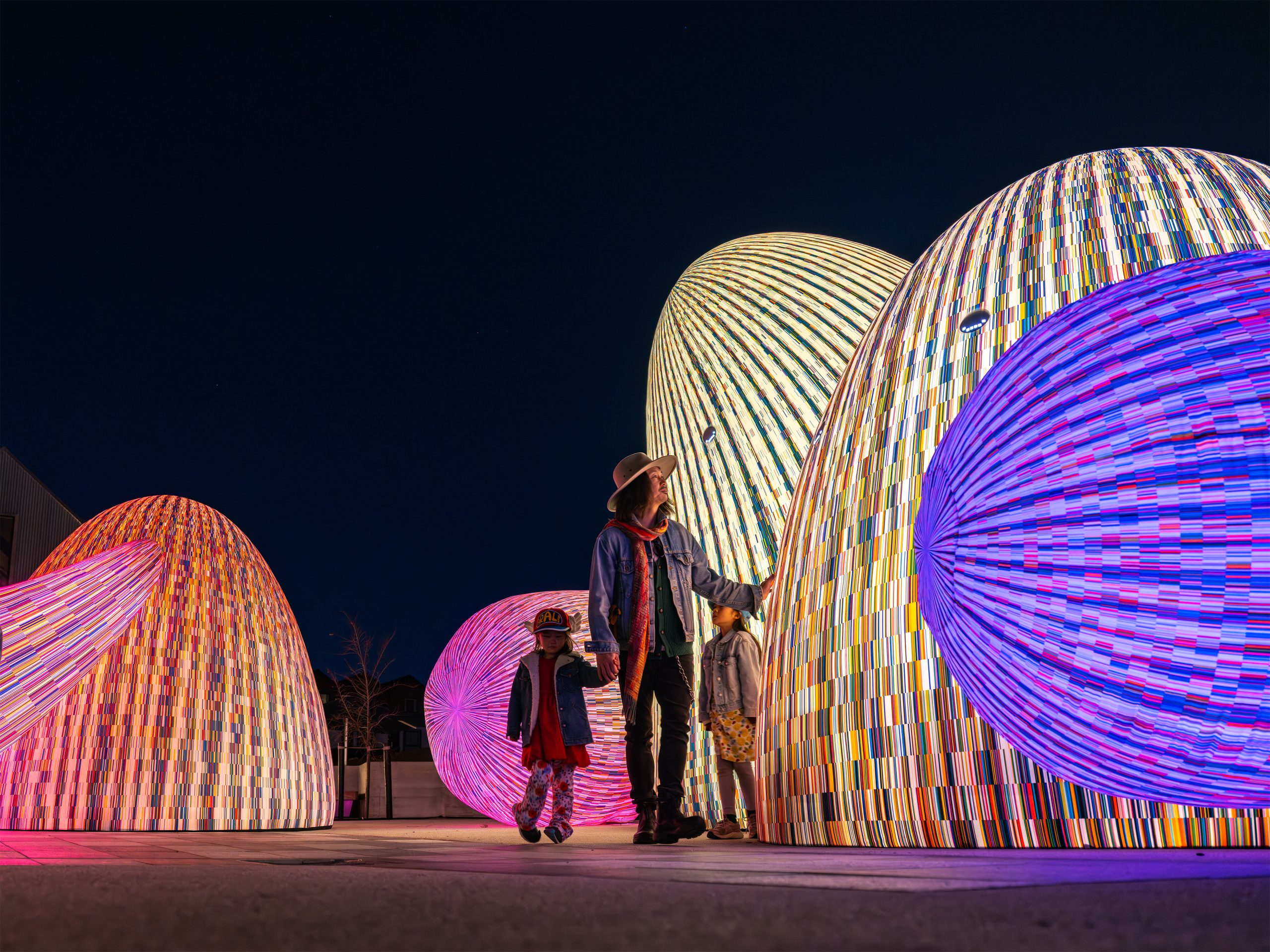
They stretch out their long, soft arms – almost as if they wanted to touch people. And it is not uncommon for this gesture to turn into an embrace: people stroll through these ‘Whispering Mountains’ by the Australian studio ENESS, pause for a moment and long to be close to them. Perhaps it is down to their form, which combines the artificial and the natural in a unique way. Although shaped like a natural landscape familiar to us, these mountains are enriched with digital textures and a digital life of their own. Each mountain whispers brief thoughts to visitors: messages developed by artificial intelligence that invite reflection.
In this way, the ‘Whispering Mountains’ create conscious moments of slowness in an age of constant acceleration. Just as in real mountains, where people forget the time to find peace and clarity, this artwork also offers moments in which time is not measured but consciously experienced.

Biography
ENESS was founded in 1997 and is a multi-award-winning art and technology studio. The team creates temporary and permanent interactive art in public spaces that combines various disciplines such as sculpture, textile art, design, programming, music, and storytelling. At the heart of all of ENESS’s work is the connection across generations. As pioneers of new media art, the collective believes in the power of art in everyday life to spark the imagination and bring joy, happiness, and beauty to unexpected places—transformative experiences that change lives.

Credits
Whispering Mountains designed by ENESS (@studioeness)

This installation was realized with the kind support of Grazer Wechselseitige realized.

04

Continuum

Robin Beekman
+

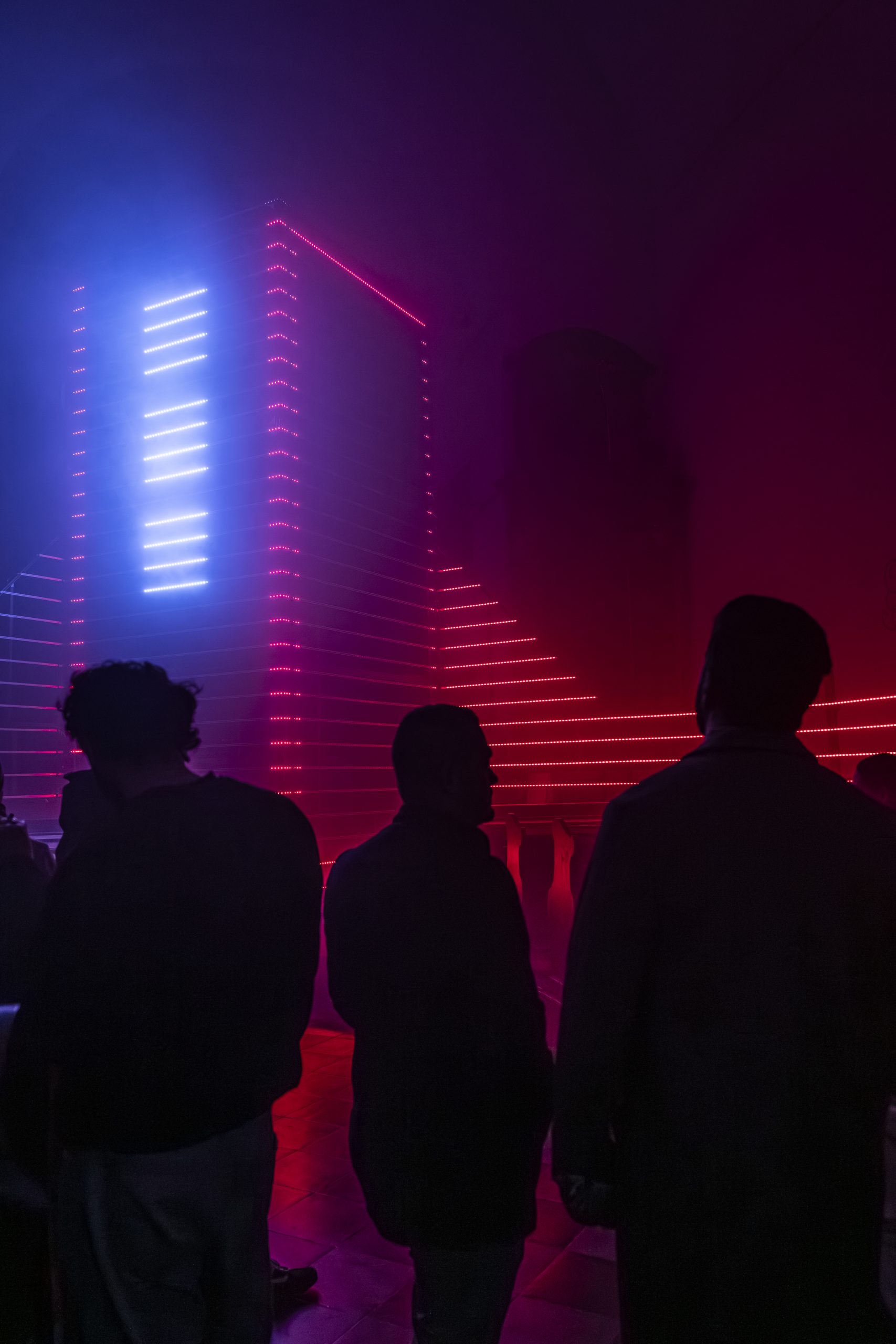
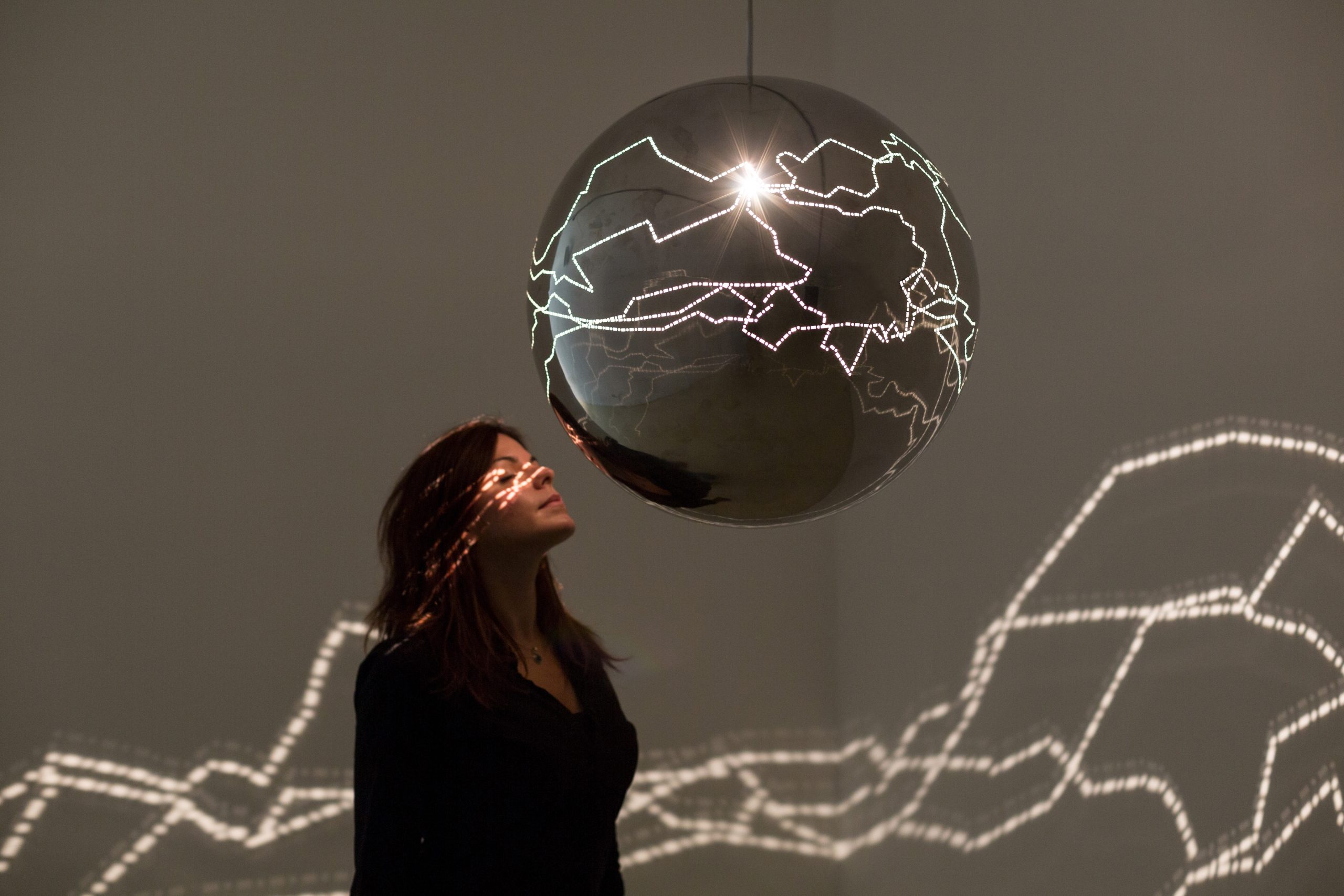
Inspired by historical planetariums, the Dutch artist Robin Beekman measures time in a new way in the castle chapel of Eggenberg Castle: ‘Continuum’ counts the seconds since the artwork’s creation, thereby following its own ‘biological clock’. However, the seconds in the work are not all the same; in the randomness of this timekeeping, one second is slower, another faster. Twenty-four specially developed lights react to these uneven units of time and produce an equally random, constantly changing pattern of light.
Far removed from our familiar 24-hour rhythm, ‘Continuum’ is a unique constellation of the present: when time begins and when it ends recedes into the background. Rather, it is a sense of time all of its own – and at the same time a sense of endlessness – that arises with this work.

Curated by Zalán Szakács.

Biography
Robin Beekman is a visual artist who explores light, technology, perception, and spatial interventions. He studied visual and media technology and has established an artistic practice that focuses on the transformative effects of light on human perception and the experience of the environment.
In his work, he explores visual phenomena, optical illusions, and the interaction between technological systems and physical space. Through kinetic light installations and immersive environments, Beekman creates situations in which visitors become aware of their own perception.

Credits
Concept & artistic work: Robin Beekman
Sound: Reinald van Praet

This installation was realized with the kind support of the Mondriaan Fonds realized.

05

Migratory Senses

Helga Griffiths
+

Scents evoke memories – and can transport us to other places, to other times. A prime example of this is Muhammad Aszizi and the scent of his Syrian homeland, which reminds him of the landscape of his childhood, the plants, the earth and the atmosphere. The story of this refugee lies at the heart of Helga Griffiths’ project ‘Migratory Senses’, which focuses on smell as the sense capable of immediately evoking memories within us.
This fusion of art and neuroscience illustrates something both ordinary and extraordinary: time here is not linear, but is stored within us as a combination of perception, emotion and memory, and can be revived at any moment – for example, through a scent. In this way, ‘Migratory Senses’ tells not only of flight and home, but also of the universal, deeply human longing for places that have shaped us.

Biography
Helga Griffiths works at the intersection of art and science. In her multimedia installations—which engage the senses—she explores biological processes, human perception, and the way the brain processes information, emotions, and memories. In doing so, she translates scientific findings into poetic spaces of experience, making visible or tangible what often eludes immediate perception.
A particular focus of her artistic work is the sense of smell and its close connection to memory. Griffiths views scents as carriers of personal and collective memories: they can bring past places, people, and phases of life back to the present in an instant. Her works thus challenge linear conceptions of time and make memory tangible as a physical, emotional experience.

Credits
Concept & artistic work: Helga Griffiths
Sound: Johannes S. Sistermanns

06

jahres licht weiss

Inge Dick
+

How does light change with the passage of time? What we cannot perceive with our eyes – or see only as a snapshot – is made visible by Inge Dick’s artwork ‘jahres licht weiss’. Over the course of several years, the artist captured the changing play of light’s colours in a white room. Her interest lay primarily in the subtle nuances determined by the natural changes in the seasons.
The resulting large-format film stills, on display in the Planetarium Hall at Eggenberg Palace, are precisely constructed compositions of spring, summer, autumn and winter. The cycle is not merely a comparison of colour spectra, but visualises what we ourselves feel: that every season has its own light and, with it, its own atmosphere.
In the context of the space, the installation takes on further significance: the hall, with its Baroque imagery, depicts a cosmological system featuring zodiac signs, cardinal points, days and nights. With its seasons, ‘jahres licht weiss’ subtly expands the existing space.

Biography
Inge Dick studied at the University of Applied Arts Vienna and began her artistic career as a painter. Through the photographic documentation of her own paintings, she discovered photography—and with it, the theme that continues to shape her work to this day: light as an independent creative medium.
In experimental photographic works, large-format Polaroids, and films, Inge Dick explores the interplay between light, color, space, and time. Her focus is not on spectacular events, but on the subtlest changes in natural light: the transition from the first glow of dawn to daylight, atmospheric shifts over the course of a day, or the varying moods of light throughout the seasons. She does not view color as a static quantity, but as the result of the interplay between material and light.
A defining feature of her work is her consistent observation of the barely perceptible. Through photographic and cinematic magnification, she makes fleeting moments of light visible and sensitizes the viewer to changes that often go unnoticed in everyday life. Her minimalist works deliberately forgo additional media effects and unfold their impact solely through light, space, and time.

Credits
Concept & artistic work: Inge Dick
Production Coordination: Matthias Pöschl
Production: BGD – Lettering, Graphics, Printing

This installation was realized with the kind support of BGD – Beschriftung, Grafk, Druck realized.

07

Planet 9

Miriam Hamann
+

Knowledge is valid only until it is disproved. The astronomical symbolism at Eggenberg Palace illustrates this, as does the work of Miriam Hamann, whose installation ‘Planet 9’ creates a dialogue between the palace’s historical worldviews and contemporary ones.
The starting point is the hypothetical Planet 9 on the edge of our solar system. No telescope has yet been able to image it. Current research deduces its existence solely from mathematical calculations and the unusual orbits of other objects. The fact that science operates here not on the basis of certainty but of probability forms the core of Hamann’s work. The focus is therefore on the background to this potential discovery rather than on the planet itself: the artist transforms astronomical diagrams into a minimalist yet poetic light sculpture that allows the scientific process of discovery to be experienced spatially. In this way, ‘Planet 9’ tells not only of the evolution of knowledge over time, but also of the willingness to continually question established ideas.

Biography
Miriam Hamann, whose works straddle the line between sculpture and installation, combines scientific abstraction with visual clarity.
In her installations and sculptures, Miriam Hamann (*1986, Wels) explores scientific phenomena and their influence on our understanding of the world. By questioning their validity, she reveals systems of order as malleable constructs and asks what happens when we let go of the illusion of complete control. Her works open up a space for reflection at the intersection of science, philosophy, and the often intangible dimensions of our reality.

Credits
Concept & artistic work: Miriam Hamann

08

Abiosis

Heleen Blanken
+

Stones, fragments and relics in the Lapidarium in the grounds of Eggenberg Palace transport visitors to a time long past. ‘ABIOSIS’ by Heleen Blanken builds on this look back: inspired by the speculative ‘primordial soup’, the installation turns back the clock to a moment of becoming, when life first emerged from inanimate matter. Blanken’s sculptures are unmistakably mechanical, yet they appear to be breathing. This creates a connection between the inanimate and the animate, adding a temporal dimension to the context of the Lapidarium: the beginning.
The fact that this contemporary element, situated within the historic complex, also creates scope for new interpretations is entirely intentional: at the interface between technology and the organism, the beginning of new life can refer not only to a moment in the past, but also to a speculative future of artificial life forms.

Biography
Heleen Blanken is an interdisciplinary artist based in Amsterdam who works at the intersection of installation art, new media, film, set design, and sculpture.
She studied fine arts at the Gerrit Rietveld Academy. In her artistic practice, she explores the complex relationship between humans and nature and examines how we perceive and interact with nature. By addressing traditional dichotomies such as organic versus artificial and analog versus digital, her work raises questions about our understanding of the natural environment and crafts speculative, futuristic narratives.
Heleen’s works have been shown in exhibitions worldwide, including at the Nxt Museum, the Stedelijk Museum Amsterdam, the
Kunstkerk Dordrecht, the Stedelijk Museum Schiedam, the Floriade World Expo 2022, the Gropius Bau Berlin, the Ron Mandos Gallery, the Musée d’art Contemporain, and Ars Electronica. She has collaborated with institutions such as the Naturalis Biodiversity Center in Leiden, the Museum für Naturkunde in Berlin, and the Institute for Geosciences in Utrecht.

Credits
Concept & artistic work: Heleen Blanken
Abiosis (iteration)
Engineering: Daniel de Bruin
Technical support: Jessie van den Broek

This installation was realized with the kind support of the Mondriaan Fonds realized.

09

Resonances of the invisible Order

Javier Riera
+

Javier Riera always responds to the location of his work: to the architecture and its history, and to nature. In Eggenberg Palace Park, visitors encounter two large-scale light projections by the Spanish artist, which harmonise seemingly contradictory impressions: they are monumental and surprising, yet at the same time calm, almost meditative, and despite their sheer size, they blend seamlessly into their surroundings. The luminous, geometric forms are not foreign elements, but appear almost natural – like structures that had previously remained hidden from view and are now revealed by the light.
The light installations draw on both the park, which evolved from a Baroque to a Romantic garden, and the palace with its astronomical orientation. In this way, ‘ ’, the installation deliberately alludes to the mutability of human thought, scientific knowledge and historical conceptions of nature and the cosmos.

Biography
Javier Riera is known for his land art and projection-based works, which explore the intersection between geometry and nature—a relationship that lends his installations a meditative quality. His goal is to expand the viewer’s perception toward an experience of visibility and connection with the energy of nature. His works have been shown at numerous light art festivals worldwide, exhibited at leading museums such as the Museo Reina Sofía and MUSAC in Spain, and are part of major public and private collections.

Credits
Concept & artistic work: Javier Riera
Sound: Luminecho
Collaborators: Rosalina Fernández, Javier Palomo

This installation was realized with the kind support of voestalpine Metal Engineering Division realized.

10

Floral Forest

Joschua Hohenbrink
+

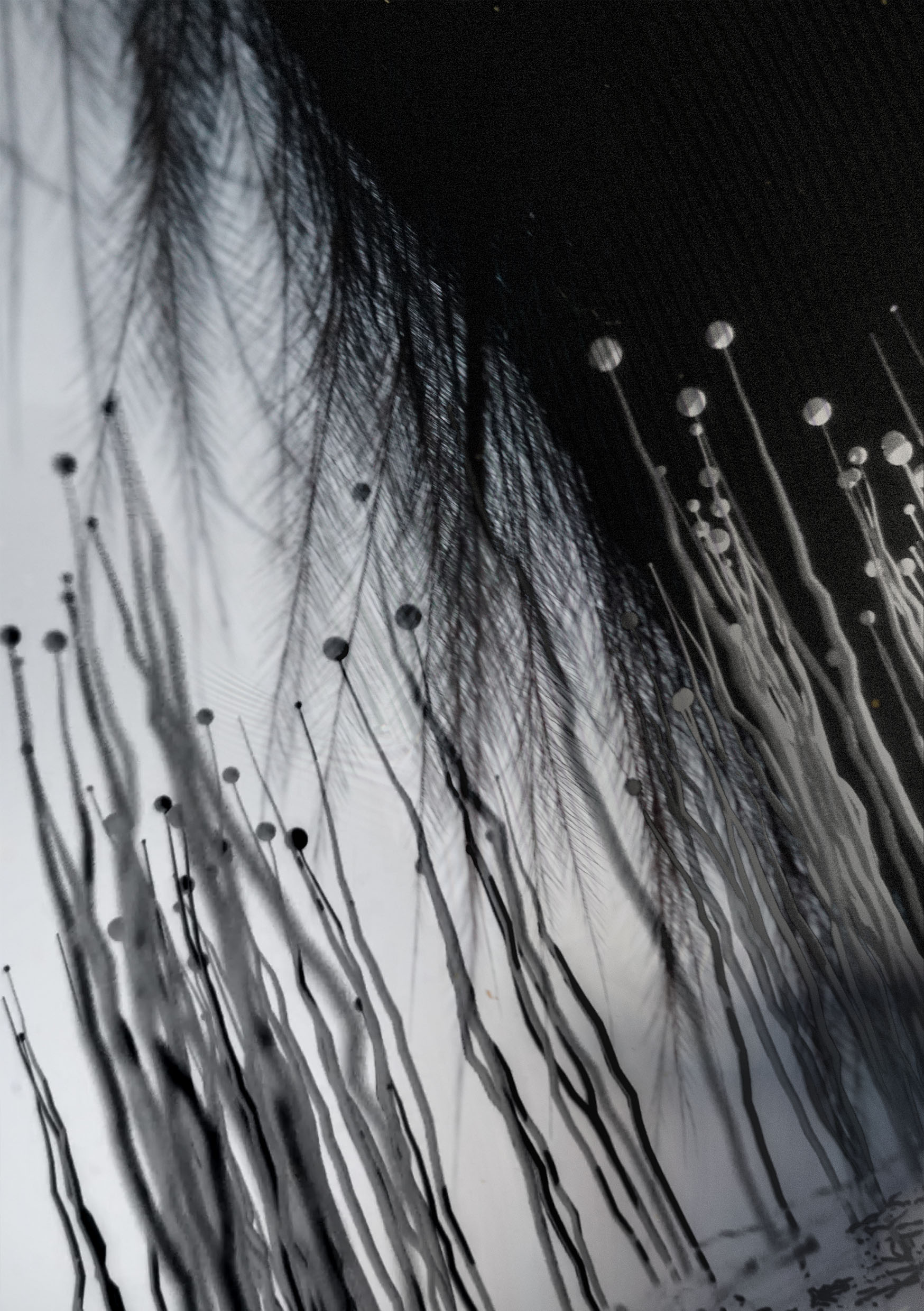
Slowly yet inexorably, the historic pavilion in Eggenberg Palace Park is undergoing an apparent transformation. Its distinctive architecture, complete with the impressive ceiling painting, merges with the surrounding natural landscape to form the art project ‘Floral Forest’ by Joschua Hohenbrink: abstract Rococo ornaments grow into the pavilion like organic life, climbing up its walls and giving rise to a poetic, sensuous forest. Woven into this digital tapestry are live analogue images of a raven’s feather – the heraldic animal of the Eggenberg family – creating a work of art that never looks the same – at no hour, on no day.
With ‘Floral Forest’, the pavilion in the castle grounds is expanded without actually changing. Like an echo from the past, light and sound spread throughout it, offering a new perspective on this historic site.

The sound accompanying the video mapping is by sound designer Gregor Schmitz, who previously provided the soundscape for Olafur Eliasson’s ‘Eye See You’ project at KLANGLICHT 2025.
The project is being realised as part of the “KLANGLICHT Young Masters” programme.

Kuratiert von Zalán Szakács.

Biografie
Joschua Hohenbrink, digital artist and creator (born 1986, Germany), works as a freelancer and artist, specialising in audiovisual installations and projection mapping. Studied Media Art (BFA, AKI ArtEZ, Netherlands); currently undertaking a Master’s in Arts and Design at FH Joanneum (Austria), focusing on atmosphere in sacred spaces and video mapping. Work has been presented at events including Klanglicht Graz, the Generate! Festival and international exhibitions, with projects in the fields of video mapping, soundscapes and interactive installations.
Gregor Schmitz is studying Sound Design at FH Joanneum in Graz and is aiming to complete his Master of Arts in 2026. Last year, as part of a collaborative project, he created the sound design for Olafur Eliasson’s work ‘Eye see you’, which was shown at KLANGLICHT.

Credits
Concept & artistic work: Joschua Hohenbrink
Sounddesign: Gregor Schmitz

This installation was realized with the kind support of Raiffeisen Landesbank Steiermark realized.

11

All the light you see

Alicia Eggert
+

When we gaze up at the starry sky, we know that the light reaching our eyes has been travelling for millions of years. This phenomenon also applies – and we are far less aware of this – to every other form of light. Even when light travels only from a nearby object to our eyes, every glance reveals a moment that has, in fact, already passed.
The large-scale installation ‘All the light you see’ plays with this very passage of time. In a three-second rhythm – the duration that many cultures perceive as a ‘moment’ – words fade in and out, altering their collective meaning. This interplay of language, light and darkness makes the present moment immediately tangible. The realisation that every glance is a glimpse into the past becomes all the more evident within the historical context of Eggenberg Palace.
At the same time, the work’s message also points to the future, for with every moment new light emerges and with it new possibilities. ‘All the light you see’ thus becomes a poetic reflection on transience, perception and hope.

Biography
Alicia Eggert (b. 1981, USA) is an American conceptual artist and sculptor whose interdisciplinary works explore the relationships between language, light, and time. Inspired by physics and philosophy, she translates abstract concepts into large-scale installations that combine scientific insights with poetic experience. She gained international recognition in particular for her animated neon works, in which language takes on an additional layer of meaning through movement, rhythm, and light.
With her installation “All the Light You See,” Alicia Eggert transforms a physical fact into a poetic reflection on perception, transience, and the present moment—themes that are directly linked to the curatorial theme of “time.”

Credits
Concept & artistic work: Alicia Eggert
Production: Andreas Albaner

12

The Self at 50 Hertz

Omer van Soldt
+

‘The Self at 50 Hertz’ is like a stenographer who records and condenses everything that happens: a carousel with twelve symmetrical mirrors reflects the room and, thanks to its high rotation frequency of up to 50 hertz, combines all the mirror images into a single image of the surroundings. To achieve this, the Dutch artist Omer van Soldt drew inspiration from early optical illusions and animation techniques, translating their concept into a contemporary context. In doing so, the work mirrors its own exhibition venue not only literally but also figuratively: the Baroque Eggenberg Palace set amidst our present day.
As viewers approach the installation, their presence is also captured as a reflection, integrated into the generated image and thus becomes one with the historic space. This participatory element is not merely playful in nature; it also invites viewers to reflect on themselves as part of their own environment.

Biography
Omer van Soldt is an artist, author, filmmaker, and curator whose interdisciplinary practice explores communication, language, and the mechanisms through which meaning is constructed and exchanged. In his work—which spans performance, installation, film, theater, and research-based projects—he examines both the possibilities and the failures of communication in contemporary society.
Van Soldt moves fluidly between gallery spaces, theater productions, festivals, and collaborative research environments. In his work, he frequently explores how artistic forms can function as alternative languages to create new forms of dialogue between artists, audiences, and public space.
He is currently affiliated with the ArtScience program in The Hague and is an active member of interdisciplinary initiatives that bring together visual art, performance, light, and sound.

Credits
Concept & artistic work: Omer van Soldt

This installation was realized with the kind support of the Mondriaan Fonds realized.

13

Prism

Students from FH Joanneum, Institute of Design and Communication
+

The world can also be viewed as if through a prism: not in one direction, but in several at once. Using light and sound, students from FH Joanneum explore various themes from the world of Eggenberg Palace and incorporate their individual works into the overarching project ‘Prism’. The various fields of study – Interaction, Sound and Media Design – form the basis for the wide range of artistic works, which explore themes such as mythology, astrology and polyrhythms.
The resulting installation is not only open to the public; with every step, the relationship between light, sound and the audience changes. The result is a multi-layered spectrum of movement, colours and sounds that constantly reconfigures itself depending on the viewer’s perspective.

The project was supervised by Astrid Drechsler, Daniel Fabry, Michael Kernbichler, Didi Mosbacher and Roman Pürcher.

This installation was realized with the kind support of the Kleinen Zeitung realized.
14

Energy in Time

Zeineb Kaabi
+

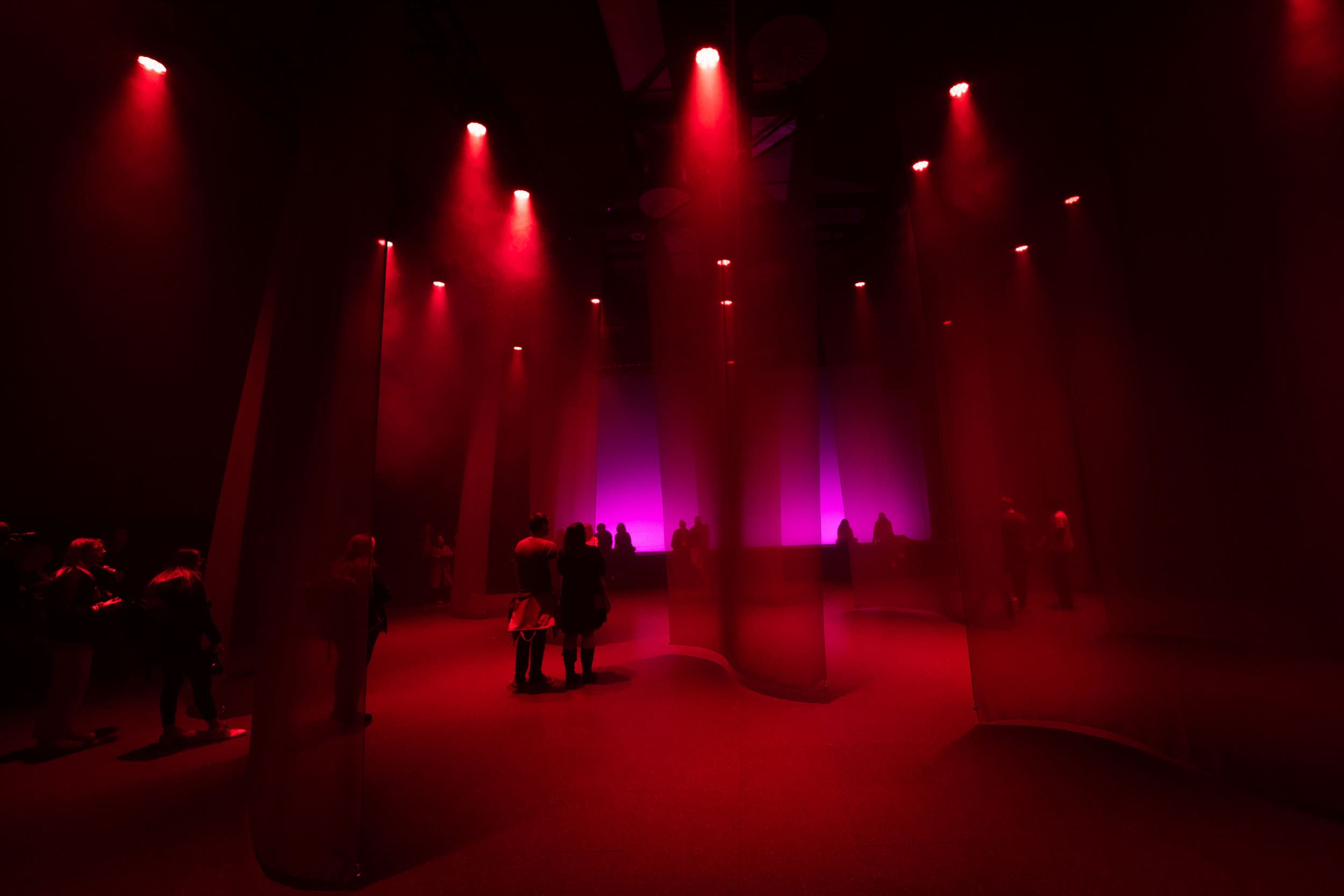
Progress, consumption, decay – and ever-increasing energy consumption to sustain them. With her project ‘Energy in Time’, Zeineb Kaabi explores the commercialisation of products and the associated consumption of resources. For her video installation, the Tunisian artist condenses archive footage and historical adverts into a visually striking kaleidoscope. The rapid montage of the material, repetitions and superimpositions, combined with deliberate colouring and additional image generation, convey a sense of unease, restlessness and even overwhelm.
The destructive cycle of creation, exploitation and depletion is thus translated into a work of art that, through the lens of the past, poses questions about the present and the future: How do our own consumption patterns and the systems behind them take shape today? And what impact will they have on tomorrow?

Curated by Zalán Szakács.

Biography
Zeineb Kaabi (born 1999 in Tunis) is a Tunisian media artist whose work operates at the intersection of artistic research, social issues, and digital imagery. She studied social and cultural anthropology in Tunis and developed her artistic practice largely through self-study.
In her work, Kaabi focuses in particular on the relationship between humans, society, and the environment. She explores how our use of energy, water, land, and natural resources is transforming our living spaces and ecosystems. Her projects often draw on scientific data, archival materials, and intensive research, which she translates into generative images, video works, projections, and site-specific installations.
Since participating in the 2021 INTERFERENCE Young Masters Program, Kaabi has been regularly featured internationally. Her works have been presented at INTERFERENCE and SEE DJERBA in Tunisia, LUNA Young Masters in Leeuwarden, the GOLDSTÜCKEN in Gelsenkirchen, the LICHTROUTEN in Lüdenscheid, and the Shubbak Festival in London, among other venues.

Credits
Concept & artistic work: Zeineb Kaabi

This installation was realized with the kind support of the Industriellenvereinigung Steiermark realized.

00

+

Discover a place where you can feel and see energy, a space to settle in, pause and help shape things, an island where you can recharge your batteries right in the heart of the action.

00

Fractal Code

XAL in collaboration with 13&9 Design and Fractals Research
+

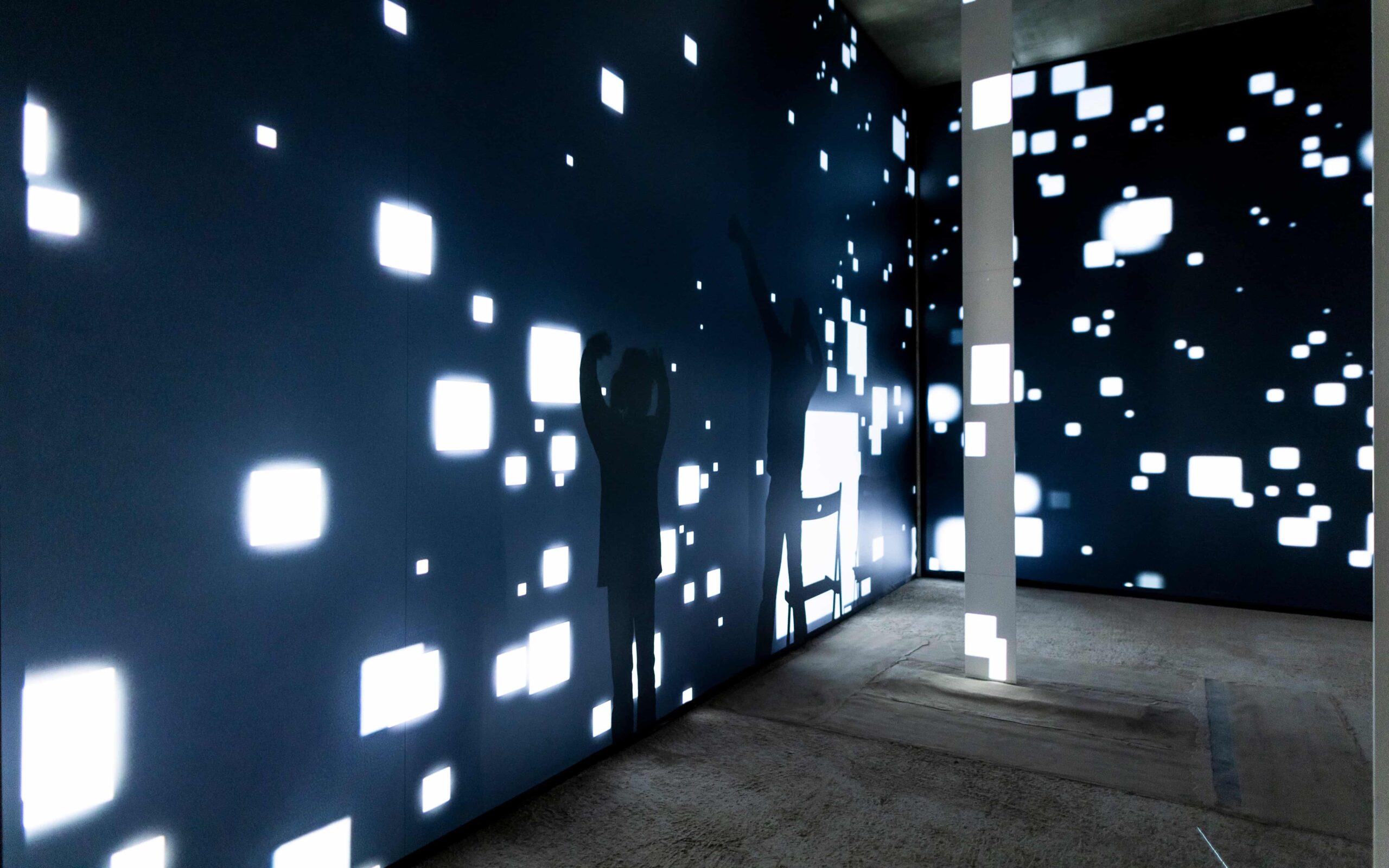
FRACTAL CODE transforms space into an immersive interplay of light, shadow and projected fractals. Fractals are the building blocks of many patterns found in nature. What begins as a coherent structure is progressively reduced: form becomes grid, grid becomes pixel, pixel becomes isolated fragment. Through the layering of transparent planes, a state emerges between visibility and dissolution.
The installation explores how meaning is created when an image can no longer be perceived as a whole, but only through its individual components. It is light that reunites the scattered elements. Within the projected shadow, the fragments aggregate into a new entity, revealing that the whole is greater than the sum of its parts.
The underlying fractal pattern was developed in collaboration with 13&9 Design and Professor Richard Taylor (University of Oregon and Fractals Research). Research has shown that certain fractal patterns can trigger a natural relaxation response, helping to reduce stress and support well-being. The result is a space that challenges perception while simultaneously offering moments of calm, contemplation and regeneration.

FAQ

When and where will KLANGLICHT take place at Eggenberg Castle?

+

KLANGLICHT Graz will be taking place at Eggenberg Palace from 23 October to 7 November 2026. The various venues in the palace grounds and inside Eggenberg Palace will be in continuous use from 6.00 pm to 10.00 pm on exhibition days.
Admission to KLANGLICHT at Eggenberg Palace is only possible with a valid ticket. Entry is staggered and is only permitted during the time slot specified on the ticket. Admission is strictly at the selected time only. These are 6.00 pm, 7.00 pm, 8.00 pm or 9.00 pm. Opening hours on exhibition days are from 6.00 pm to 10.00 pm.
Tickets are now available from the Bühnen Graz ticket centre and online here.

How much does a ticket for KLANGLICHT at Eggenberg Palace cost?

+

Ticket price: €19 (advance booking) / €24 (on the door)
Children up to the age of 7 accompanied by an adult: free
Reduced price for young people up to the age of 19 / students / those doing community service / apprentices / people with disabilities: €10.50 (advance booking) / €15.50 (on the door)
Styria Card holders: €10.50 (advance booking)
Hunger for Art and Culture: free (advance booking)
The discount for Styria Card holders is available exclusively in advance – we therefore recommend taking advantage of this offer in good time.
Different prices apply at the box office. When purchasing online, you can choose between the standard full price and the reduced price for young people up to the age of 19, students, those doing community service, apprentices and people with disabilities.

Hunger auf Kunst und Kultur
As a partner of the ‘Hunger auf Kunst und Kultur’ initiative, we enable people who, due to their current circumstances, cannot afford to pay for admission to KLANGLICHT to collect a voucher for a KLANGLICHT ticket from the ‘Hunger auf Kunst und Kultur / Steiermark’ office using their Kulturpass. The voucher can then be redeemed at the Bühnen Graz ticket centre – further details can be found on the voucher itself.

‘Free Public Transport’ with HOLDING GRAZ to KLANGLICHT at Eggenberg Palace:
With a valid KLANGLICHT ticket, you can use all public transport services within Zone 101 free of charge for two hours before and two hours after your visit. This includes buses and trams within the Graz city area.

Do I need a ticket to attend KLANGLICHT at Eggenberg Castle?

+

Yes, a valid ticket is required to attend KLANGLICHT at Eggenberg Castle.
Admission is only possible with a ticket booked in advance for a specific time slot. Entry is permitted exclusively at the selected time.
Opening hours on exhibition days are from 6.00 pm to 10.00 pm.

Where are the individual installations located?

+

The installations are located in Eggenberg Palace and in the palace grounds. You can find more detailed information here on our website.

How can I find out more about the installations?

+

Information about the installations is available in the KLANGLICHT fold-out map and on our website. The fold-out map provides an overview of all locations and installations at Eggenberg Palace and is available here, at the ticket centre and on site.
In addition, the KLANGLICHT audio guide will be available online on our website shortly before the event. You can also access the audio guide directly on your mobile phone on site via a QR code, and it provides fascinating background information on the installations.

What does the KLANGLICHT ticket include?

+

The KLANGLICHT ticket entitles you to visit KLANGLICHT at Eggenberg Palace. It includes access to all installations within the palace and the palace grounds.

‘Free Public Transport’ with HOLDING GRAZ to KLANGLICHT:
With a valid KLANGLICHT ticket, you can use all public transport services within Zone 101 free of charge for two hours before and two hours after your visit. This includes buses and trams within the Graz city area.

Are there any catering options at KLANGLICHT?

+

Yes. Refreshments are provided: a variety of food and drink options await you both in the castle grounds and in the area in front of Eggenberg Castle. This means you can also enjoy your visit to KLANGLICHT from a culinary perspective.

What happens in the event of rain, bad weather or a storm – and what happens to my ticket?

+

KLANGLICHT at Eggenberg Palace generally takes place whatever the weather – true to the motto: ‘There’s no such thing as bad weather, only bad clothing!’ So: dress for the weather and off you go.
Important in the event of rain: please hand in wet jackets and coats at the cloakroom before entering the castle rooms. This will help to protect the historic and listed premises from damp.
Should Eggenberg Palace Park have to be closed due to bad weather, a storm or for safety reasons, your ticket will of course remain valid. In this case, you will be informed by email about when and how you can reschedule your visit to KLANGLICHT.

What should you bear in mind when visiting the castle park?

+

Eggenberg Castle Park is a historically significant and sensitive site. To help us protect this special place together, we ask you to observe the following rules:
• Dogs are not permitted (with the exception of assistance dogs).
• Please do not walk on the lawns or flower beds (except in the designated picnic area).
• Please follow all signs and do not enter any cordoned-off areas of the park.
• Climbing trees is not permitted.
• Plants must not be removed or damaged.

• Bicycles, scooters and skateboards must not be used in the castle park.

• Smoking is prohibited throughout the castle park.
Thank you for helping to protect Eggenberg Palace Park and its natural environment through your behaviour.

Can I bring my dog to KLANGLICHT at Eggenberg Palace?

+

No, dogs are not permitted in Eggenberg Palace Park. This is in accordance with the current park regulations at Eggenberg Palace. Assistance dogs are exempt from this rule.
We ask for your understanding and request that you leave your four-legged friend at home during your visit.

How are nature and animals – particularly the protected bats – taken into account at KLANGLICHT at Eggenberg Palace?

+

The protection of the historic site, nature and the animals living in the castle grounds is a top priority in the planning and staging of KLANGLICHT. Particular attention is also paid to the strictly protected horseshoe bats found on the grounds of Eggenberg Castle.
All installations, as well as the lighting, sound and visitor guidance systems, were inspected by the relevant authorities in advance and coordinated with the competent specialist departments. The necessary permits have been obtained; an explicit declaration of no objection has been issued for the staging of KLANGLICHT at Eggenberg Palace.
In collaboration with the Universalmuseum Joanneum and the relevant authorities, every effort is being made to minimise any potential impact on wildlife and the natural environment and to consistently implement all necessary protective measures.

KLANGLICHT for Everyone

+

KLANGLICHT stands for a respectful, inclusive and accessible arts event that is open to everyone.

Experiencing KLANGLICHT together:
KLANGLICHT sets an example and makes inclusion an integral part of the event: in close cooperation with our partners, KLANGLICHT places inclusion at the centre of its mission to help raise awareness and break down barriers.
A festival for the whole family
KLANGLICHT is designed as an experience for a wide audience and is explicitly aimed at children too. As it takes place in an open-air venue in autumn, we recommend warm clothing, suitable footwear and supervision appropriate to the children’s ages.

Audio guide:
An exclusive KLANGLICHT audio guide will accompany you through the festival and provide in-depth information about the artists, their works and the individual installations.

Accessibility:
Where local conditions permit, all installations are accessible. See also: Is KLANGLICHT accessible?

Awareness:
It is important to us that everyone feels comfortable and safe during the festival. We therefore ask our visitors to treat one another with respect and solidarity. For us, ‘Awareness’ means being attentive to and conscious of discriminatory structures and behaviour that crosses boundaries. This includes, for example, sexism, racism, queerphobia, ableism, anti-Semitism or other forms of discrimination. For us, ‘Awareness’ also means that everyone should have the opportunity to receive help when they need it.
If you feel unsafe or uncomfortable in a situation, or if you see that someone else needs support, security is the first point of contact during the festival.

KLANGLICHT aims to be a pleasant and safe place for all visitors.
The team is available at info@klanglicht.at for any suggestions, ideas or questions.

What measures does KLANGLICHT take in the area of sustainability?

+

KLANGLICHT is certified as a Green Event, thereby sending a clear signal in favour of sustainable and responsible event organisation. The careful use of resources, nature and the venues is an integral part of the festival’s planning and implementation.
Since 2015, the Bühnen Graz art festival has been bringing selected locations in the city to life through light and sound – always with the aim of respectfully combining art, existing architecture and the surrounding environment.
This applies particularly to KLANGLICHT at Eggenberg Palace: with Eggenberg Palace and its historic park, the festival takes place in an extraordinary and sensitive setting. Accordingly, the protection of the historic site, the careful use of nature and resources, and an implementation that is as environmentally friendly as possible are incorporated into the planning from the very outset.
You can find more detailed information and a full overview of KLANGLICHT’s sustainability measures here.

Can I get to Eggenberg Palace by car?

+

It is generally possible to travel to Eggenberg Castle by car. Please note, however, that public parking spaces around the castle are very limited. To ensure a sustainable and stress-free journey, we therefore strongly recommend using public transport.

‘Free Public Transport’ with HOLDING GRAZ to KLANGLICHT at Eggenberg Castle:
With a valid KLANGLICHT ticket, you can use all public transport services within Zone 101 free of charge for two hours before and two hours after your visit. This includes buses and trams within the Graz city area.

Accessible parking spaces are available in front of the castle grounds.

How do I get to Eggenberg Castle?

+

The walk from the park entrance to the castle is approximately 300 metres and follows unpaved paths. Please note that the KLANGLICHT installations are spread throughout the entire castle park and in areas within the castle itself, meaning that visitors will need to walk longer distances during their visit.
We therefore recommend comfortable, sturdy footwear suitable for the weather.

Is KLANGLICHT at Eggenberg Palace accessible?

+

The paths around the castle are lightly gravelled but easily navigable – including for wheelchair users. The toilet facilities are accessible. The door to the Planetarium Hall has a minimum width of 80 cm.
Further information on accessibility can be found here.

Do you have any questions?

+

We are constantly updating our FAQs to ensure they are always up to date. If you have any questions that haven’t been answered yet, we’d love to hear from you – please send a quick email to info@klanglicht.at.

REVIEW KLANGLICHT

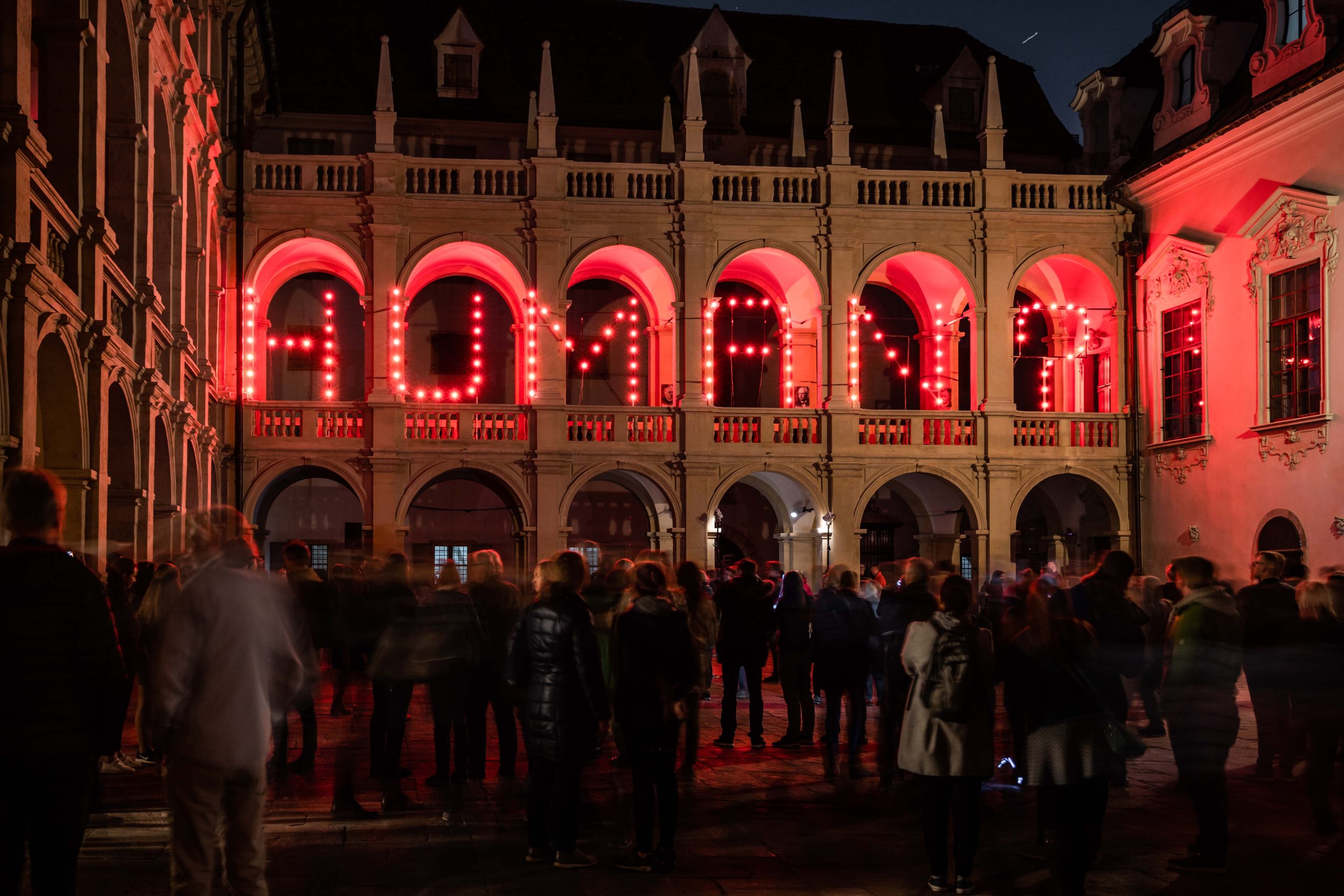
2019 Arkestra of Light - Polarized by OchoReSotto (c) Marija Kanizaj 22022 Sonderfall des Rechtecks by Esther Stocker (c) Marija Kanizaj 22022 Those Sounds are wrapped in Scars by Antonia Manhartsberger (c) Alex Koch 12022 Limbo by Antoni Arola (c) Monika Krall 22022 Limbo by Antoni Arola (c) Luke Goodlife 42023 Strom by FH Joanneum © Julian Tatzl 32023 The ice is melting at the Poules by Ball & Brand (c) Marija Kanizaj 12023 Der blaue Planet by Deutsches Zentrum für Luft- und Raumfahrt (c) Aman Maller 52024 Ohne Titel (Fragen Projektion) by Fischli & Weiss (c) Marija Kanizaj 52024 Unveiled by OchoReSotto (c) Alex Koch 22024 Visual Piano by Laurenz Theinert (c) Julian Tatzl 52024 Unveiled by OchoReSotto (c) Luke Goodlife 12024 REM by Gudrun Barenbrock (c) Alex Koch 42024 EINDER - surface by Boris Acket (c) Julian Tatzl 92025 Arkestra of Light - Lifted by OchoReSotto (c) Marija Kanizaj 5
2022 Blue Sky by Kari Kola (c) Marija Kanizaj 42022 Drawing in Space by Jeongmoon Choi (c) Marija Kanizaj 32022 Constellations by Hartung & Trenz (c) Luke Goodlife 32022 Limbo by Antoni Arola (c) Mathias Kniepeiss 12023 Arkestra of Light - Vague by OchoReSotto (c) Luke Goodlife 62023 Evanescent by Atelier Sisu (c) Luke Goodlife 32023 Arkestra of Light - Vague by OchoReSotto (c) Luke Goodlife 32023 Shadow Whispers by Martina Tritthart (c) Marija Kanizaj 12023 Der blaue Planet by Deutsches Zentrum für Luft- und Raumfahrt (c) Luke Goodlife 32024 OM by Studio MO-YA (c) Alex Koch 32024 Visual Piano by Laurenz Theinert (c) Julian Tatzl 42025 Echoes of light by Onionlab (c) Marija Kanizaj 6SLIDER 2019 HUMAN by Sophie Guyot (c) Alex Koch
Our Partners